


Skip to content
01
02
Watch
On Stem Cell Care India




Quick answer
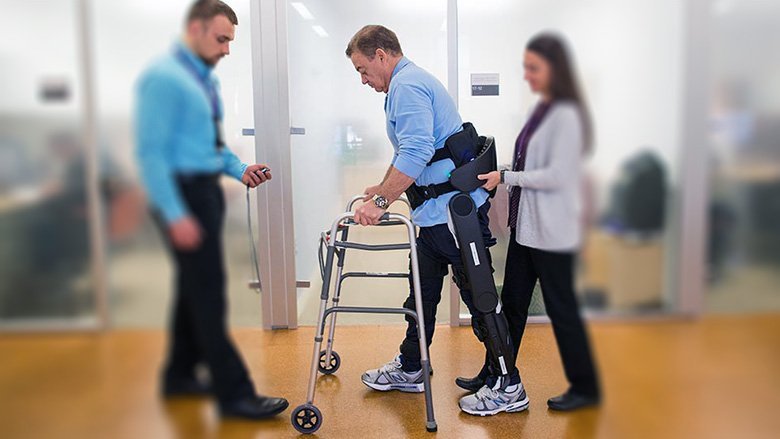
The spinal cord injury walking track is a supervised, equipment-supported mobility program where eligible patients practice structured walking using parallel bars, harness systems, or assistive devices, guided by a physiotherapist. It is part of a broader rehabilitation plan, and suitability depends on the level and completeness of the spinal cord injury.
Spinal Cord Injury Walking Track — Quick Facts
| Aspect | What to expect |
|---|---|
| Format | Supervised, equipment-supported walking practice on a dedicated track |
| Supervised by | Physiotherapists trained in spinal cord injury rehabilitation |
| Eligibility basis | Level, completeness, and stability of the spinal cord injury |
| Equipment used | Parallel bars, harness/support systems, or assistive walking devices |
| Coordination | Part of the broader physiotherapy and rehabilitation plan |
| Outcome guarantee | None — functional gains vary significantly by injury severity |
On this page — 2 topics
01What the Walking Track Program Involves
Topic 01 of 2Skip ahead: Who Is Typically Eligible
The short answer, before the detail below.
At Stem Cell Care India, we offer Spinal Cord Injury Walking track assistance that has been proven effective in a variety of spinal cord conditions and helped patients achieve better mobility or manage their condition more effectively. We have achieved high success rates, and our procedures are extremely safe. Our services are all-inclusive as we have skilled neurologists, physiatrists, occupational therapists, psychologists, speech therapists, and aquatic therapists all in one single facility.
If you are a victim of a spinal cord injury and fed up with bed-rest or wheel-chair and dream of carrying out the activities of daily life more effectively and ambulation, you sure are in need of a spinal cord walking track.
What is the importance of the Spinal Cord Injury Walking Track?
We facilitate neural plasticity and improve neural connectivity. At Stem Cell Care India, we help stimulate the injected stem cells and guide them to target damaged areas where the cells need to exert their actions. Neuro-rehabilitation stimulates nerve and supporting cell function in the brain and spinal cord through the release of growth factors, improved oxygenation, and increased blood supply. After the damaged neural pathways have been regenerated, goal-directed rehab helps them to develop connections and thus improve motor functions. This is how our leading Spinal Cord Injury Walking Track assistance in Delhi, India helps repair damaged areas of the spinal cord.
02Who Is Typically Eligible
Topic 02 of 2
Assessed individually before a program is recommended.
- Patients with incomplete spinal cord injuries retaining some motor or sensory function below the injury level
- Patients who are medically stable and cleared for supervised weight-bearing activity
- Patients already engaged in a broader physiotherapy and rehabilitation program
- Patients for whom the care team has assessed suitability alongside options like epidural stimulation
Related Videos
More videos from the Stem Cell Care India team and our patients.
The Patient from Manipur, Physiotherapy session for Spinal cord injury at SCCI | Stem Cell Therapy
Patient with Spinal Cord Injury shares his experience at SCCI| Stem Cell Therapy for SCI in India
Patient with Spinal Cord Injury shares his experience after stem cell therapy - Stem Cell Care…
Stem Cell Therapy for Spinal Cord Injury | Patient Shares Real Experience
From Trauma to Hope: D12 Spinal Cord Injury Recovery With Stem Cell Therapy | India Patient Story
Patient with Motor Neuron Disease and Spinal Cord Injury shares his experience at SCCI| MND & SCCI
See also:Supportive TherapiesphysiotherapyStem Cell Care Indiasuccess ratesstem cells
Continue Exploring
Related reading, picked for this page.
Supportive Therapy
Epidural Stimulation Treatment: How It Works for…
Epidural stimulation treatment in India.
Read more Supportive TherapyPhysiotherapy in India: Rebuilding Strength,…
Physiotherapy in India.
Read more Supportive TherapyAqua Therapy: Water-Based Rehabilitation for…
Aqua therapy in India.
Read more Stem Cell TherapyStem Cell Therapy: How It Works and Who It May Help
Stem cell therapy.
Read more ResourceFrequently Asked Questions About Stem Cell Therapy…
Frequently asked questions.
Read more Get StartedAppointment
Book appointment stem cell care India.
Read more
About this guide: This page is written, reviewed, and medically approved as credited above, and is not a substitute for individualized medical advice. See our full treatment disclaimer for details.
Keep exploringEpidural Stimulation Treatment: How It Works for Select Spinal Cord Injury CasesUmbilical Cord Stem Cell Therapy ExplainedAqua Therapy: Water-Based Rehabilitation for Mobility & Strength
Explore related topics
More depth on the subjects covered in this guide.
Supportive Therapies
The full rehabilitation ecosystem overview.
Epidural Stimulation Treatment
Supporting neural activity in select spinal cord injury cases.
Physiotherapy in India
Rebuilding strength, mobility, and physical function.
Rehabilitation Therapy in India
The broader rehabilitation framework.
Occupational Therapy in India
Rebuilding independence in daily activities.
Aqua Therapy in India
Water-based exercise for reduced joint loading.
Still have a question?
Every case is different. A free medical evaluation gets you a direct, physician-reviewed answer for your specific condition — typically reviewed within about 7 working days.
Keep reading
Articles You May Interest
Watch
Related Videos


Ready to take the next step?
Talk to a case coordinator about your specific condition and treatment options.
24–48hFrom sending your reports to a doctor-reviewed answer
10,000+Patients treated across 65+ countries
4.9 / 5From 196+ verified Google reviews