Can Stem Cells Regenerate Organs? Research and Evidence
Stem cells may replace certain types of cells and support tissue repair in the body, but rebuilding an entire human organ remains the subject of active research. Some stem cell-based treatments are established for specific conditions, while whole-organ regeneration is still under study. Progress varies by condition or organ, cell type and the strength of clinical evidence.
Key Takeaways
-
- Stem cells can replace certain cells and support tissue maintenance, but whole-organ regeneration remains a major research challenge.
- Different stem cell types have different roles and clinical applications.
- Stem cell-based treatments are established for some conditions, while many organ-regeneration approaches remain experimental.
- Findings from laboratory studies do not necessarily translate into successful treatments for humans.
- Researchers must assess treatment safety and effectiveness through appropriate clinical evidence.
Can Stem Cells Regenerate Organs?
As stem cell research advances, scientists often ask whether stem cell-based approaches can restore an organ damaged by disease or injury. This is one of the questions that drives research in regenerative medicine today. However, replacing tissue is not the same as rebuilding an organ. Stem cells can grow into different types of cells, raising the possibility of replacing certain damaged cells and supporting the body’s tissue repair.
Researchers are still investigating how stem cells may support regeneration in organs such as the heart and kidney. But the progress varies across different organs, and promising laboratory investigations do not always result in effective human treatment. Understanding what current research says helps distinguish established medical uses from experimental approaches.
What Are Stem Cells, and How Do They Support Tissue Repair?
Stem cells are considered unique cells that develop into specialised cell types. They help maintain certain tissues by replacing cells that are lost or damaged. The regenerative capabilities of stem cells are dependent upon the specific types of stem cells and tissues.
-
- Self-Renewal: Stem cells have the capacity to generate more stem cells and maintain themselves.
- Differentiation: In the right circumstances, they have the ability to form specialised cells like blood cells or skin cells.
- Tissue Replacement: Some stem cells help replace cells as part of tissue renewal.
But simply replacing individual cells is not sufficient for the repair of an entire organ. Complex organs need structured tissue organisation along with the coordinated functions of the cells.
Which Types of Stem Cells Are Used in Regenerative Medicine?
Different types of stem cells have different parts to play in treatment and research. Their clinical use depends on their ability to produce specific cells and the level of evidence available to support their safety and effectiveness.
-
- Haematopoietic Stem Cells (HSCs): These stem cells are found in bone marrow and blood. These cells help produce blood cells in the body and are also used in an established transplantation approach for certain blood-related conditions and disorders.
- Mesenchymal Stem Cells (MSCs): Mesenchymal stem cells are studied for their potential to influence inflammation and tissue repair. Some proposed applications remain investigational.
- Tissue-Specific Stem Cells: These cells are tissue-specific and work by regenerating cells that are lost due to natural cell turnover. Their use is being researched to regenerate injured tissues.
- Pluripotent Stem Cells: Embryonic and induced pluripotent stem cells are capable of forming a number of cell types. Their use is under investigation to see whether they have the capability of producing specialised cells.
However, this is just one of the many aspects involved in the process of regenerating organs. The biggest challenge lies in the correct functioning of these cells in an organ system.
How Do Stem Cells Contribute to Organ Regeneration?
Scientists are actively studying different stem cell approaches to support tissue repair in different organs. The approach varies because each organ has distinct cell types and structural requirements.
-
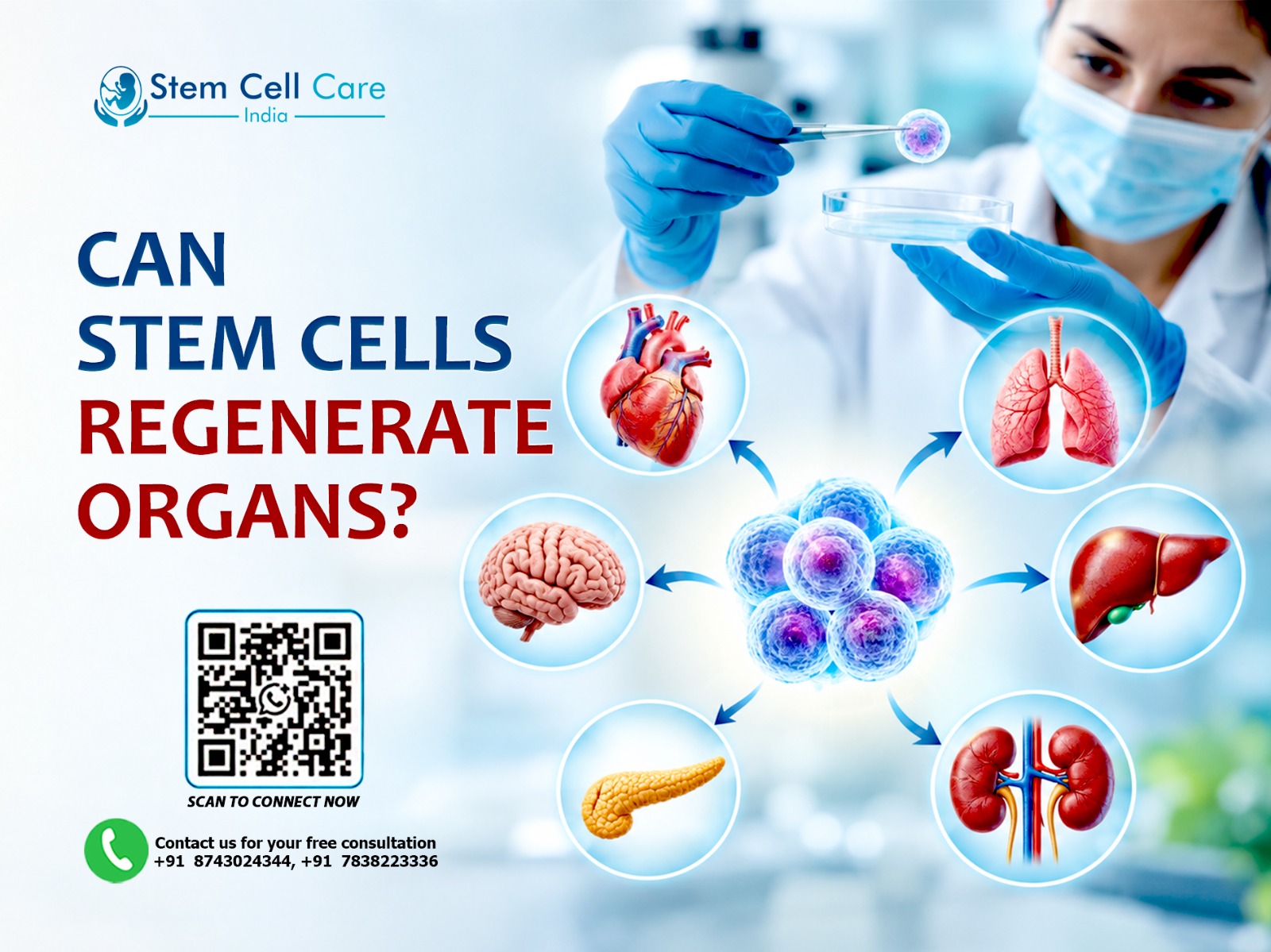
- Heart: Researchers are studying to determine whether pluripotent stem cells obtained from heart muscle could help replace damaged tissue and improve overall heart function.
- Liver: Liver cells derived from stem cells are being studied in relation to disease modelling and possible future use in regenerative therapies.
- Kidneys: Researchers are trying to find ways to make specialised kidney cells and even structures similar to the kidneys.
- Lungs: Scientists are examining the possibility of using stem cells to generate lung cells, both of which participate in the functioning of air sacs and airway linings. All techniques are experimental at this time.
- Nervous System: Stem cell studies are exploring the possibilities of using specialised nerve cells and supporting cells for dealing with injuries caused by diseases like spinal cord injury and neurodegeneration.
These methods are still in various stages of research. Just because the cells are created in a laboratory does not mean that they will be able to heal an organ within a person.
If you’re curious about whether stem cell therapy may restore damaged organs, always ask if the current available evidence supports the safety and effectiveness of the proposed approach for your specific condition. Promising laboratory findings alone do not establish clinical benefit.
What Have Clinical Trials Demonstrated So Far?
Clinical human trials have shown that stem cell-based approaches may improve certain aspects of organ function, but evidence on complete organ regeneration remains limited.
Here are some studies that distinguish between promising outcomes and established approaches:
-
- Heart Disease: After the 2014 Cardio133 trial, researchers have found some important improvements related to heart muscle function and blood flow after bone marrow cell treatment. However, the treatment did not improve left ventricular function and clinical symptoms compared with the control group.
- Advanced Liver Disease: A study was published around 2025 by the Cochrane organisation, reviewing 12 studies involving 823 different individuals with decompensated cirrhosis. According to the study, there was insufficient evidence to make conclusions regarding the benefits of stem cell therapy, including survival rates and other relevant factors.
These results show how important it is to assess clinical outcomes with caution. Blood flow changes, lab results, and even improvement in symptoms don't indicate organ regeneration.
Clinical trials are required to determine which treatments work and are safe to use for particular illnesses.
What Are the Risks and Limitations of Stem Cell-Based Organ Regeneration?
Before considering any new medical approaches, it’s important to understand the procedure's potential risks and benefits. Stem cell-based approaches' risks often depend on the types of cells, how they are prepared and delivered, and the patient's condition.
Potential concerns include:
-
- Immune Response: The immune system of the recipient might respond to the implanted cells.
- Abnormal Cell Growth: Certain cell types, such as pluripotent cells, have the potential to develop tumours because of uncontrolled proliferation and differentiation.
- Cell Transplantation Complications: Infection, bleeding, and damage to the adjacent tissues may result from the transplant process.
- Uncertain Long-term Outcomes: Some methods have insufficient follow-up data on which to evaluate their efficacy and safety.
Other drawbacks involve the challenges of obtaining cells that fit into the structure of a complex organ. Patients need to ensure that the therapy suggested is licensed for their disease, supported by clinical data, and supervised by professionals. Approaches under clinical study are not established as a routine medical approach.
Looking Ahead
If you are exploring stem cell therapy for organ damage, seek guidance from a qualified medical professional before considering any procedure. Stem Cell Care India provides educational information to help patients prepare informed questions for their treating physician. Contact Stem Cell Care India to learn more about stem cell research and prepare for an informed discussion with your healthcare provider.
Frequently Asked Questions
Q1. Can stem cells regenerate a completely damaged organ?
No. Researchers are investigating ways to regenerate organ tissue, but rebuilding an entire human organ using stem cells is not an established routine treatment.
Q2. Which organs are being studied for stem cell-based regeneration?
Research includes the heart, liver, kidneys, and lungs, as well as the nervous system. Progress varies by organ, cell type, and stage of research.
Q3. Can stem cells grow into any type of organ cell?
No. Their potential depends on the type of stem cell. Pluripotent stem cells can develop into many cell types, while tissue-specific stem cells have more limited potential.
Q4. How long does it take for stem cells to regenerate damaged tissue?
There is no universal timeline. Outcomes depend on the cell type, the condition being studied, the delivery method, and the treatment's intended purpose. Complete organ regeneration cannot be assumed.
Q5. Are stem cell-based organ regeneration treatments approved for patients?
Approval depends on the specific treatment, its intended use, and the applicable regulatory requirements. Patients should verify the authorisation status of a proposed procedure before proceeding.
Q6. Can stem cell therapy replace an organ transplant?
Stem cell therapy cannot currently be considered a general replacement for organ transplantation. Patients should discuss established treatment options with a qualified specialist before considering experimental approaches.
Q7. How can patients assess claims about stem cell-based organ regeneration?
Look for published human clinical trial results, independently reviewed evidence, clear information about risks, and authorisation for the specific medical use. Laboratory findings or testimonials alone do not establish effectiveness.
References
(1) National Institutes of Health. Introduction to Stem Cells.
Retrieved from: https://stemcells.nih.gov/info/basics/stc-basics/#stc-I
(2) Hoang DM, Pham PT, Bach TQ, et al. (2022). Stem cell-based therapy for human diseases. Signal Transduction and Targeted Therapy, 7, 272.
Retrieved from: https://doi.org/10.1038/s41392-022-01134-4
(3) Nishinakamura R. (2023). Advances and challenges toward developing kidney organoids for clinical applications. Cell Stem Cell, 30(8), 1017–1027.
Retrieved from: https://doi.org/10.1016/j.stem.2023.07.011
(4) Vazquez-Armendariz AI, Tata PR. (2023). Recent advances in lung organoid development and applications in disease modeling. Journal of Clinical Investigation, 133(22), e170500.
Retrieved from: https://doi.org/10.1172/JCI170500
(5) Nasseri BA, Ebell W, Dandel M, et al. (2014). Autologous CD133+ bone marrow cells and bypass grafting for regeneration of ischaemic myocardium: the Cardio133 trial. European Heart Journal, 35(19), 1263–1274.
Retrieved from: https://doi.org/10.1093/eurheartj/ehu007
(6) Aung HH, Naing C, Ni H, Aye SN, Htet NH, Kew ST, Pavlov CS. (2025). Human stem cells for decompensated cirrhosis in adults. Cochrane Database of Systematic Reviews, 11, CD015173.
Retrieved from: https://doi.org/10.1002/14651858.CD015173.pub2
(7) International Society for Stem Cell Research (ISSCR). (2025). Guidelines for Stem Cell Research and Clinical Translation.
Retrieved from: https://www.isscr.org/resources/guidelines-for-stem-cell-research
(8) Long HY, Qian ZP, Lan Q, et al. (2024). Human pluripotent stem cell-derived kidney organoids: Current progress and challenges. World Journal of Stem Cells, 16(2), 114–126.
Retrieved from:https://doi.org/10.4252/wjsc.v16.i2.114
Medical Disclaimer
This blog has an informative purpose only and cannot be used as a substitute any form of medical consultation. Stem cell technologies for organ regeneration are at various research stages, and some of them are still experimental. It is recommended to contact a specialist for information on existing treatment options and the risks connected with them. Do not forget to find out about the regulatory status of any suggested therapy using stem cells before deciding on the treatment.